Innovate or Run Adrift: Poland’s Economic Growth Map 2026–2035
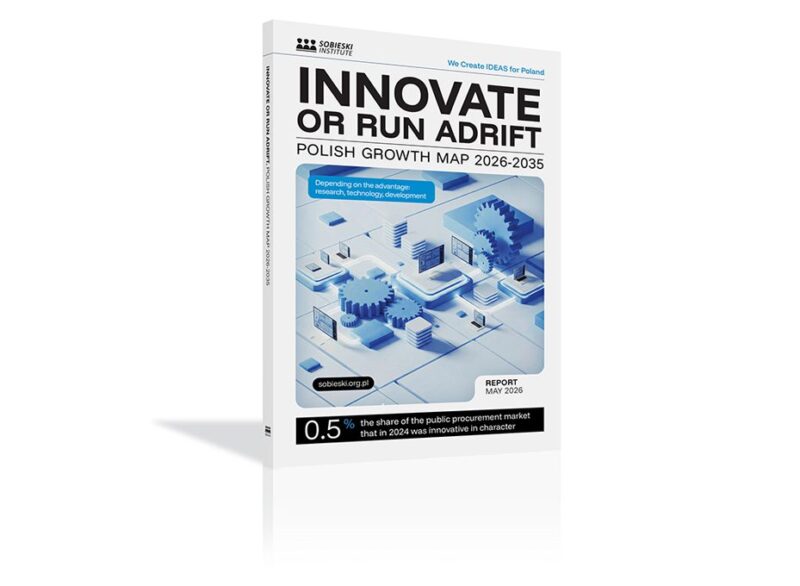
The Sobieski Institute has published a report entitled “Innovate or Run Adrift: Poland’s Economic Growth Map 2026–2035”, examining the evolution of the national innovation ecosystem over the past decade and identifying the strategic trajectories that will determine Poland’s technological standing by 2035.
The report was authored by:
– Jadwiga Emilewicz
– Piotr Dardziński
– Jakub Kaczmarski
– Bartłomiej Pawlak
– Wojciech Przybylski
A Decade of Progress Without a Breakthrough
Over the past ten years, Poland has tripled its expenditure on research and development — from approximately 1.0% of GDP in 2015 to 1.56% in 2023. Total R&D spending reached PLN 53 billion. At the same time, the financing structure of the innovation ecosystem underwent a profound transformation: the private sector now accounts for 65% of total R&D expenditure, compared with 39% a decade ago. The number of people employed in research and development activities has risen to 326,000.
Despite these advances, Poland remains classified as an “emerging innovator,” achieving only 66% of the EU average innovation performance. The share of high-technology products in exports remains more than twice as low as in Europe’s most advanced economies. The authors stress that, while the past decade delivered tangible progress, it did not produce a systemic breakthrough. Poland has yet to establish mechanisms capable of effectively translating research into durable technological advantages and sustained productivity growth.
The Tax System as an Innovation Accelerator
The report proposes a comprehensive policy toolkit covering the entire technology lifecycle — from concept development to commercialization:
- a 200% tax deduction for automation, robotics, and AI investments, including refundable mechanisms for non-profitable firms, modelled on the UK’s R&D Tax Credit scheme;
- a refundable R&D tax incentive covering all forms of employment, alongside cash reimbursements for pre-revenue companies and SMEs;
- a pilot and prototype tax relief enabling deductions for industrial testing and technology demonstrators;
- an enhanced IP Box+ regime (4% CIT/PIT) during the initial years of commercialization, with the possibility of combining incentives;
- tax and social contribution preferences for R&D personnel to support the development of high-performance technology teams.
Enterprises as the Engine of the Innovation System
Corporate R&D expenditure increased almost fivefold, reaching PLN 34 billion. Market-based instruments — particularly tax incentives and the expansion of the venture capital ecosystem, including programs implemented by PFR Ventures — played a decisive role. Companies utilizing these incentives currently undertake 1.5–2 times more R&D projects than before the reforms.
At the same time, the report identifies persistent structural barriers: low patent application rates, a capital gap at the scale-up stage for technology companies, the marginal use of innovative public procurement mechanisms (approximately 0.5% of the market), lengthy project evaluation procedures, and the absence of a dedicated defence technology agency.
Strategic Technologies for Future Growth
The authors identify two pillars of Poland’s future technological growth.
The first encompasses sectors with an already established industrial base, including green chemistry, next-generation mobility, and agri-food technologies.
The second concerns domains critical to national security and technological sovereignty: semiconductors, artificial intelligence and post-quantum cryptography, nuclear energy and energy storage, space technologies, as well as predictive medicine and longevity technologies.
The State as an Operator of Strategic Capabilities
The report advances the thesis that Poland requires a “second breakthrough” — a transition from the model of the state as regulator to the state as an operator of technological capabilities. This would entail deploying public procurement and the tax system as genuine instruments for building competitive advantage.
Key recommendations include:
- broader application of innovation-oriented criteria in public procurement and the expansion of pre-commercial procurement (PCP);
- technological pilot programs in strategic sectors such as energy, healthcare, cybersecurity, and transport;
- simplification of administrative procedures;
- the introduction of a comprehensive package of pro-growth tax incentives, including the 200% deduction for automation, robotics, and AI, refundable R&D tax relief, pilot and prototype incentives, and an expanded IP Box+ regime.
The Stakes: Durable Technological Advantages
According to the authors, the central challenge lies in moving beyond a project-based logic toward a stronger focus on market outcomes — implementation, exports, and productivity growth. Success will ultimately depend on the capacity of public institutions to coordinate effectively, concentrate resources strategically, and assume responsibility for measurable outcomes.
“Innovate or Run Adrift” provides an expert diagnosis of the current state of Poland’s innovation ecosystem and outlines a strategic roadmap that may determine the country’s position within the global division of labour over the coming decade. We invite you to explore the report.